




Do you offer custom trailer axle solutions?
Yes. Duratek builds custom axles every day. If you need a specific size, capacity, or setup, we can manufacture it for you.
How do I know which axle is right for my trailer?
Start with your trailer’s GVWR, how it’s used, and the size you need. If you’re not sure, reach out and we’ll walk you through it.
Are your axles compatible with all types of trailers?
Yes. We build axles for utility trailers, enclosed trailers, deck overs, boat trailers, dump trailers, and more.
Do your axles come with hubs, bearings, and brakes?
Your choice. Order a bare axle beam or a complete assembly that’s fully greased and ready to install.
What are the weight capacities of your axles?
Duratek axles range from 2,000 lb to over 10,000 lb capacities. Check each product listing for details.
Are your axles compatible with electric brakes?
Yes. We offer axles that work with electric and hydraulic brake systems.
Do your axles come with a warranty?
Yes. Our torsion axles include a 10 year warranty, and our spring axles include a 5 year warranty.
What makes Duratek axles better?
Duratek axles are built to last. Here are a few reasons to use Duratek Axles:
• Heavy-wall pipe for stronger, longer-lasting axles. (0.188 wall on 3.5K / 1/4” wall on 5.2K – 7K)
• Fully greased hubs and drums: comes ready for up to 6,000 miles
• 80-durometre rubber in all torsion axles
• Faster lead times: one week on most orders
• Made in the USA with strict quality control
• Built to your exact specifications
• Premium bearings, seals, brakes and components
• Excellent customer support from a team that cares
How do I find my hub face if I’ve got a broken spindle or missing hub?
Look for the spindle shoulder and measure from shoulder to shoulder across the axle.
No spindle? Measure outside to outside of the brake flanges, then add the standard offset for your hub.
Still not sure? Give us your spring-center measurement and our team can help confirm the right hub face.
At Duratek, we’ll make sure you get the exact fit, even if your hub or spindle is long gone.
How far apart should I space my axles and hangers?
For most tandem-axle trailer setups, hanger spacing should match the axle spacing used in your suspension kit.
Here are reliable industry-standard guidelines:
Recommended Spacing
33” axle spacing:
→ Use approximately 29½” between the front and center hangers, and 29½” between the center and rear hangers.
35” axle spacing:
→ Use approximately 30½” between each hanger.
Important Notes
Measurements are on-center (center of bolt hole to center of bolt hole).
Exact spacing can vary depending on spring length, equalizer size, and the specific hanger kit being used.
Always confirm measurements with the suspension kit specifications you’re installing.
Why aren’t my new brakes working yet? (How do I burnish my brakes?)
Tow your trailer at about 40 mph, then apply the brakes gradually until you slow to around 20 mph.
Repeat this process 20 to 30 times.
Avoid sudden stops during burnishing because the goal is controlled heat buildup to seat the brake shoes.
After burnishing, your brakes will perform at their full capacity. If they feel weak at first, don’t worry, that’s normal.
How do you determine hanger spacing?
1. Find the Axle Spread:
First, determine your desired axle spread, which is the distance between the axle centers.
2. Consult the Spring and Hanger Manuals:
Look for a hanger spacing chart or installation manual provided by the trailer or axle manufacturer.
3. Calculate or Use Manufacturer-Provided Spacing:
The spacing between the hangers will be slightly different from the axle spread. For example, a 33-35 inch axle spread might correspond to a 29.5-30.5 inch hanger spacing.
4. Mock Up the Components:
Before permanently attaching the hangers, position them on the trailer frame.
5. Check for Proper Geometry:
Verify that the leaf springs and shackles are correctly aligned.
6. Verify Tongue Weight:
Use the provided formulas to ensure the axle and hanger layout will result in the correct tongue weight.
7. Weld Securely:
Once the position is confirmed, you can weld the hangers securely in place.
Example Hanger Spacing
A tandem axle trailer might have hangers spaced about 29.5 inches on center to achieve a 33-35 inch axle spread, depending on the specific components.
What’s better for axles — grease or oil?
Grease: Handles contamination well, resists leakage, stays consistent, and works with all seals.
Oil: Easier to drain and measure, cleaner to handle, and offers better cooling.
At Duratek, we recommend grease for most trailers; it’s dependable, low-maintenance, and keeps you on the road. Oil can be a good choice for high-heat or heavy-duty applications where extra cooling matters.
How do I find the degree of arm (articulation dimension) on my torsion axle?
The arm “degree” refers to the angle of the torsion arm that sets your trailer’s ride height.
Down angle (e.g., 45°) = higher ride height
Straight (0°) = neutral ride
Up angle (10–25°) = lower ride / drop axle effect
To measure it, check the distance from the axle centerline to the spindle center — this is the articulation dimension that tells you the arm’s degree.
How far will my torsion arm move (articulate)?

Torsion arms are designed to travel through a set arc of movement. At full load, they can swing upward and downward several inches from the starting angle. The exact articulation depends on the arm’s starting degree (up, straight, or down).
For tandem setups, make sure your axle spread is correct:
If the arms are not angled away from the center hanger, extend the spacing to about 30”.
In most cases, axle spacing should fall between 33” and 35”.
How do I correctly measure the bolt pattern on a trailer axle or wheel hub?
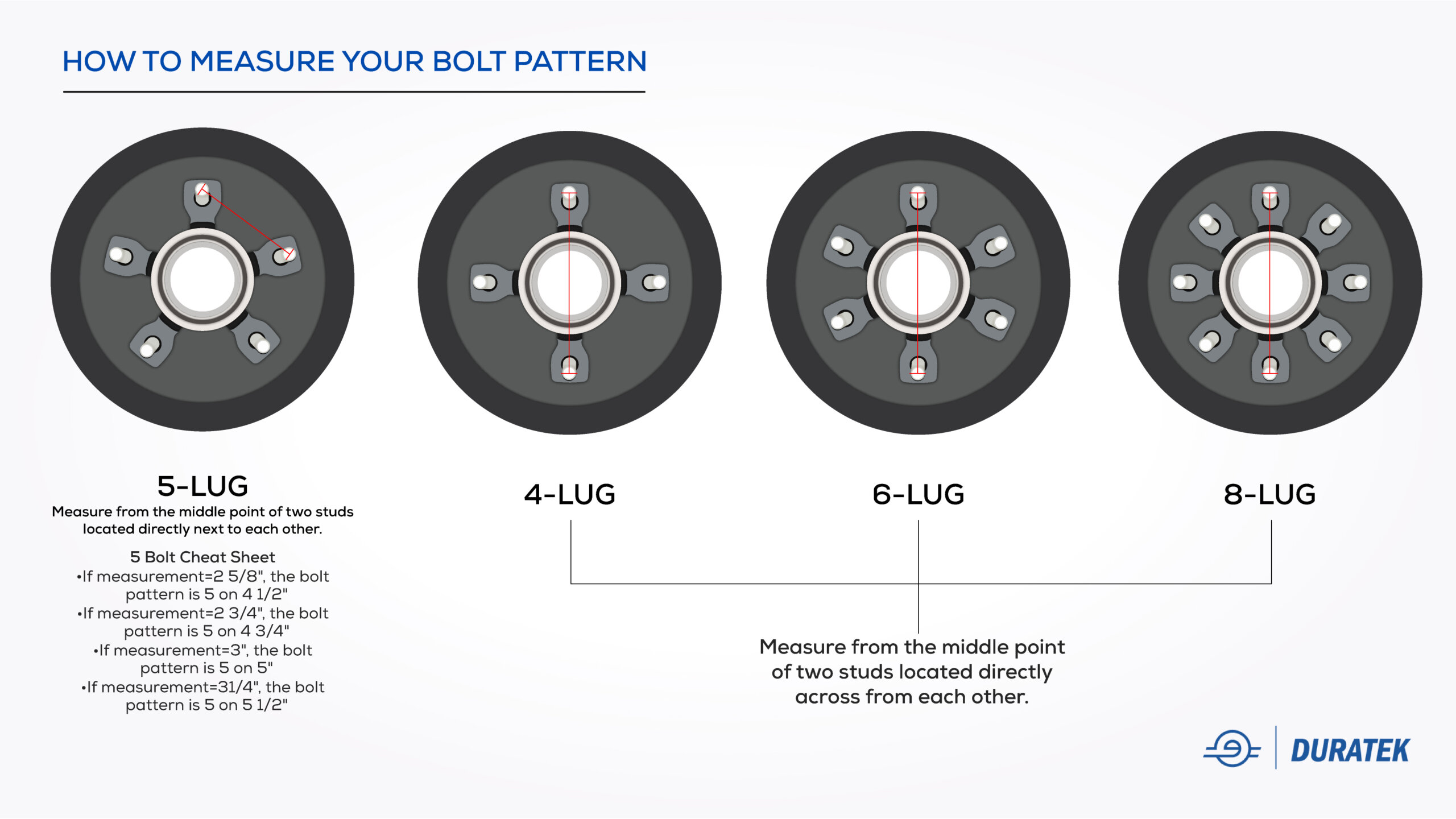
A: Here’s a step-by-step guide on how to accurately measure the bolt pattern on your trailer axle wheel hub.
1. Count the bolt holes
Trailer hubs typically come in 4-bolt, 5-bolt, 6-bolt, or 8-bolt configurations.
This first number is the “6” in “6 on 5.5,” or the “5” in “5 on 4.5.”
2. Measure the bolt-circle diameter (BCD)
How you measure depends on whether the hub has an even or odd number of bolts:
For Even Bolt Patterns (4, 6, 8-lug)
Measure from the center of one bolt hole straight across the hub to the center of the bolt hole directly opposite.
This gives you the bolt-circle diameter.
Example:
If that distance is 5.5”, your pattern is 6 on 5.5”.
For Odd Bolt Patterns (5-lug)
There’s no bolt directly opposite, so use this method:
Measure from the center of one bolt hole to the center of the bolt hole two spaces away (skip one).
That distance is your diameter.
3. Record the measurement
Bolt pattern is always written as:
Number of bolts × diameter
Examples:
5 × 4.5”
6 × 5.5”
8 × 6.5”
Quick Tip for Duratek 6-Bolt Hubs
For a 6-bolt setup, simply measure center-to-center across the hub.
This method is the fastest and most accurate since the bolts are evenly spaced.
Getting this measurement right ensures your wheel, hub, and drum fit correctly, preventing vibration, uneven wear, or unsafe mounting.
How far apart should I space my torsion axles (center wheel to center wheel)?
Ensure centerline-to-centerline spacing allows adequate load sharing and avoids undue stress on each axle.
Leave enough side-to-side clearance for tires at each axle (wheel tracks) so tires don’t interfere when the trailer flexes or rolls.
Factor in frame strength and cross-members between axles.
As a ballpark for tandem axles, you might see spacings ranging from ~30”–40” (depending on trailer width, tire diameter, load distribution), but you must verify for your specific torsion arms/brackets.
How do I identify my axle?
1. Check for a sticker
Start by looking at the back of the axle tube. Many axles have a tag or sticker with the brand, capacity, and serial number. If you find it, that’s usually all you need.
2. Measure the hubface
If there’s no label, measure from the center of one hubface to the center of the other. The hubface is the flat mounting surface where your wheel bolts on. This measurement is key for identifying your axle.
3. Measure the spring centers
Next, measure the distance between the spring centers. This tells us how the axle lines up with your trailer frame and suspension.
4. Check the suspension type
Look underneath and see whether you have a spring axle or a torsion axle.
• Spring axles have leaf springs attached to the axle.
• Torsion axles use an internal rubber torsion system and no leaf springs.
This helps narrow down what you’re working with.
5. Measure the tube diameter
Finally, measure the outside diameter of the axle tube. This helps estimate weight capacity. Here are common sizes:
Spring Axles
• 1.75 in tube = about 1,000 to 2,000 lb
• 2.375 in tube = about 3,500 lb
• 3 in tube = about 5,200 to 7,000 lb
• 3.5 in tube = about 8,000 lb
Torsion Axles
• 1.75 in tube = about 1,000 to 2,000 lb
• 2.625 in tube = about 3,500 lb
• 3 in tube = about 5,200 to 6,000 lb
• 3.5 in tube = about 7,000 lb
• 3.875 in tube = about 8,000 lb
Once you have these measurements, you’ll know exactly what you need for a replacement or upgrade. And if anything’s unclear, we’re always happy to help.
Can axle damage be repaired?
Sometimes, yes. It depends on what’s actually damaged.
Wear items like bearings, hubs, brakes, and springs can usually be swapped out without replacing the whole axle. Bearings are made to wear, hubs and brake assemblies can be replaced, and fresh components can bring an older axle back to life.
But if the axle tube is cracked or bent, or the spindle threads are stripped, replacement is usually the safest move. A broken tube weakens the entire structure, a bent tube throws off alignment, and damaged spindle threads make it tough to secure your wheel properly.
Light camber or alignment issues can occasionally be corrected by a skilled tech with the right tools, but major damage almost never bends back safely.
If your axle is showing serious wear or any structural damage, replacing it is the best way to protect your trailer, your tires, and your tow vehicle. If you need a new one, contact your nearest dealer for spring and torsion axles in a wide range of sizes. Find your closest dealer here.
What happens when a trailer axle is out of alignment?
You might notice the trailer pulling to one side, tracking weird, or feeling less stable at higher speeds.
Misalignment also puts extra stress on your suspension, bearings, hubs, and other components.
If you spot odd tire wear or your trailer isn’t tracking straight, get the alignment checked before it leads to bigger problems.